
Knurled Cabinet Handles
-
Henley Knurled Solid Brass Bar Handle
Regular price From £36.95Regular price -
Lines Reeded T Bar Cabinet Handles
Regular price From £19.95Regular price -
Crispin Knurled T Bar Cabinet Handles
Regular price From £17.95Regular price -
Stirling Reeded Solid Brass Brass Bar Handle
Regular price From £41.35Regular price -
Brunel Knurled T-Bar Cupboard Handles
Regular price From £11.75Regular price -
Crispin Reeded Cabinet T Bar Handles
Regular price From £18.95Regular price -
Knurled Solid Brass T-Bar Cabinet Handles
Regular price From £18.95Regular price -
Camille Knurled Cabinet Bar Handle
Regular price From £24.15Regular price -
Henley Knurled Solid Brass Cabinet Cup Handle
Regular price From £28.95Regular price -
Stirling Reeded Solid Brass Cabinet Cup Handle
Regular price From £30.95Regular price -
Crispin Reeded T-bar Cabinet Door Knob
Regular price From £9.35Regular price -
Lines Reeded T Bar Cabinet Knobs
Regular price £8.75Regular price -
Knurled Solid Brass T Bar Cabinet Knobs
Regular price £8.75Regular price


What are knurled cabinet handles?
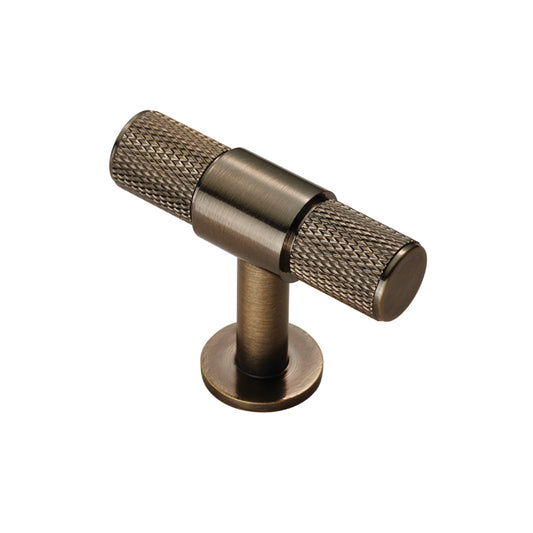
Knurled cabinet handles are defined by their textured surface, created using a precision-machined pattern that runs along the handle. Originally used in industrial applications to improve grip, this detailing introduces a more defined and structured look compared to smooth cabinet hardware.
The texture is both visual and tactile. On a simple bar or T-bar handle, knurling breaks up the surface and catches the light differently from a polished or completely smooth finish. That makes the hardware more noticeable without relying on an oversized shape or decorative backplate.
Where are knurled handles used?
Knurled handles are commonly used on kitchen cabinets, drawer fronts and fitted furniture. Their linear texture works particularly well on flat-panel cabinetry, where the surface detail adds contrast without introducing unnecessary complexity.
They can also work on shaker-style cabinetry, wardrobes, utility-room storage and freestanding furniture, particularly where the rest of the scheme is deliberately simple and the handle is intended to provide a finer layer of detail.
For kitchen projects, knurled handles can be used consistently across drawers and cupboard doors or combined with matching knurled cabinet knobs where a smaller fitting suits the cabinet front better.
Knurled handles, reeded handles and other textured finishes
Knurled and reeded handles are both textured, but the surface patterns are different. Knurling is usually formed from a repeated machined pattern that creates a more tactile, cross-cut grip, while reeding uses parallel grooves running along the handle. Reeded designs tend to create a more linear effect, whereas knurling gives the surface a denser, more technical texture.
Both styles can work in contemporary and transitional interiors, and both are often used where a smooth handle would feel too plain. The choice is largely visual: knurled handles feel more intricate and tactile, while reeded handles create a cleaner rhythm of repeated lines.
Some reeded designs also sit alongside knurled styles in this collection, so filtering by product style is the easiest way to narrow the different textured options.
Choosing knurled cabinet handles
This collection includes bar handles and T-bar handles, allowing a consistent hardware style to be used across cupboards and drawers. Many designs are available in solid brass and other durable materials, making them suitable for full kitchen layouts and coordinated furniture installations.
Knurled designs form one part of the wider choice of cabinet handles, offering a more tactile alternative to smooth bar, D and bow handle profiles.
When choosing between different knurled handles, look beyond the finish alone. The diameter or thickness of the grip, the depth of the texture, the fixing centres and the overall length all affect how substantial the handle feels on the cabinetry.
For larger drawers and wider cabinet fronts, a longer pull can give the texture more visual presence. On smaller cupboards, a shorter bar handle or matching knob may feel better proportioned. If you are comparing sizes, our cabinet handle sizes guide explains fixing centres and proportions in more detail.
Knurled bar handles, T-bar handles and matching knobs
Knurled hardware is often easiest to coordinate when the same surface detail appears across more than one fitting type. A longer bar handle can be used on wide drawers, with shorter pulls or matching knobs used on smaller cupboard doors.
T-bar handles provide a compact version of the same look, while matching cabinet knobs can be useful where a full-length handle would dominate the front. Choosing related pieces from the same range also makes it easier to keep the finish and texture consistent.
Choosing a finish for knurled handles
Finish changes the character of the texture as much as it changes the colour. Brass tones add warmth and tend to emphasise the machining as light moves across the surface. Matt black gives the pattern a stronger graphic outline, while polished nickel and chrome create more reflection between the raised and recessed areas.
Darker finishes can create a strong contrast against pale cabinetry, while satin and brushed metallic finishes tend to feel softer. Where exact colour matching matters, it is usually best to choose handles and knobs from the same range or manufacturer rather than relying on finish names alone.
Material, grip and everyday use
Some knurled cabinet handles are manufactured from solid brass, while others use different metal bases with a decorative finish applied to the surface. The individual product specification should always be checked where material is important to the project.
The textured surface can also provide a more positive grip than a completely smooth handle, particularly when opening heavier drawers or frequently used cupboards. The feel varies between designs, though: some knurling is fine and subtle, while other patterns are deeper and more pronounced.
When are knurled handles the right choice?
Knurled cabinet handles work particularly well when you want the hardware to contribute texture and detail without becoming overly decorative. They suit kitchens and fitted furniture where the cabinetry itself is relatively restrained and the handles are intended to add a more engineered or design-led finish.
They may be less suitable where the room already contains a lot of strong surface texture, or where a very quiet hardware scheme is preferred. In those cases, a smooth bar handle, D handle or simple knob may sit more comfortably with the rest of the room.
For a broader comparison of cabinet-hardware forms, see our guide to choosing cabinet handles.
Explore More Styles
-

Cup Handles
What Are Cup Cabinet Handles Our range of cup handles offers a...
-

Bar Handles
What Are Cabinet Bar Handles? Cabinet bar handles feature a straight, linear...
-

Cupboard Knobs
Cupboard knobs for cabinets and drawers For cupboards and smaller pieces of...
-

Bow Handles
Bow handles for cabinets and drawers Bow handles are valued for their...


